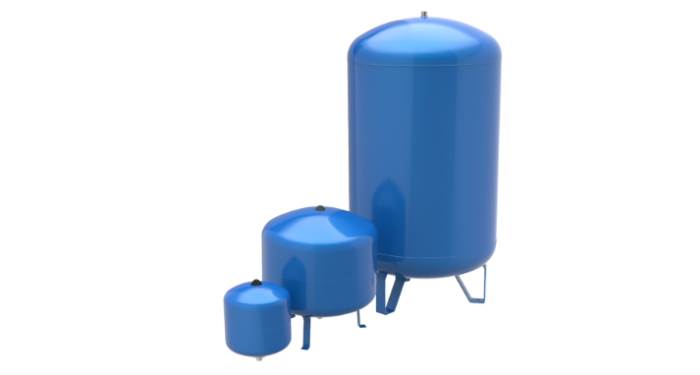
An Expansion Tank is a critical component used in closed-loop heating and cooling systems to manage the thermal expansion of water or other fluids. As water heats up, it expands, increasing the pressure within the system. Without a way to absorb this expansion, the increased pressure could damage pipes, valves, or other equipment. The expansion tank provides a cushion of air or gas that absorbs this extra volume and prevents overpressure.
Typically, an expansion tank is a sealed, cylindrical vessel divided into two sections by a flexible diaphragm or bladder. One side contains system fluid (usually water), and the other side is filled with compressed air or nitrogen. As the water in the system heats up and expands, it flows into the tank and compresses the air on the other side, thus balancing the pressure within safe limits.
Expansion tanks are used in a variety of systems, including hydronic heating systems, chilled water systems, and domestic hot water systems. By maintaining pressure equilibrium, the expansion tank helps to prolong the lifespan of the system, enhance safety, and improve energy efficiency.
Inventure offers Bladder type Expansion Tanks manufactured by ViRA – Turkey with capacity ranging from 8 Ltrs to 10000 Ltrs and Pressure options 10/16/25 Bar. Tanks with custom sizes and pressure also can be manufactured as per project requirement.
1. Outer Vessel
Shape:
Typically cylindrical or spherical for uniform stress distribution.
Material:
Carbon Steel (most common)
Finish:
Internal: Corrosion-resistant lining (in some models, especially for potable water).
External: Protective coatings such as powder coating or epoxy paint to resist rust and corrosion.
2. Internal Construction
Flexible Membrane (Diaphragm or Bladder)
Purpose: Separates the fluid and gas chambers to prevent mixing.
Materials:
EPDM (Ethylene Propylene Diene Monomer) – Common for heating systems.
Butyl Rubber – Used for high-performance or potable water applications due to better gas retention and flexibility.
Types:
Diaphragm-Type:
Membrane is fixed to the tank interior wall, creating two distinct chambers.
Simpler construction, used in many standard systems.
Bladder-Type:
Balloon-like bladder fully contains the system fluid.
Fluid is completely isolated from the tank wall, reducing corrosion risk and making maintenance easier (bladder can be replaced in some models).
3. Gas Chamber
Pre-Charged with Air or Inert Gas (e.g., Nitrogen):
Absorbs expansion volume by compressing as system fluid expands.
Pressure Setting:
Factory pre-charged, usually to match the static system pressure.
Adjustable via a Schrader valve (air valve) at the top of the tank.
4. Fluid Chamber
Connection:
Equipped with a water inlet/outlet connection, usually at the base or side.
Connects directly to the system’s fluid loop.
Function:
Receives expanded fluid during system operation, transferring pressure to the gas chamber.
An Industrial Process Chiller is made up of several essential components that work together to regulate temperature and ensure smooth operation. Each part plays a crucial role in the refrigeration cycle: