
Chemical Filtration Unit

Chemical Filtration Unit/ Air Purification System

Edgetech offers unique range of particulate matter and chemical filters for the removal of airborne contaminants & gaseous pollutants. The advanced filtration system provides tropical/economy-oriented air movement, giving pleasant, natural Himalayan like environment. Inventure Qatar is a leading provider of advanced chemical filtration units in Qatar, offering innovative solutions tailored to meet the region’s industrial and environmental needs.

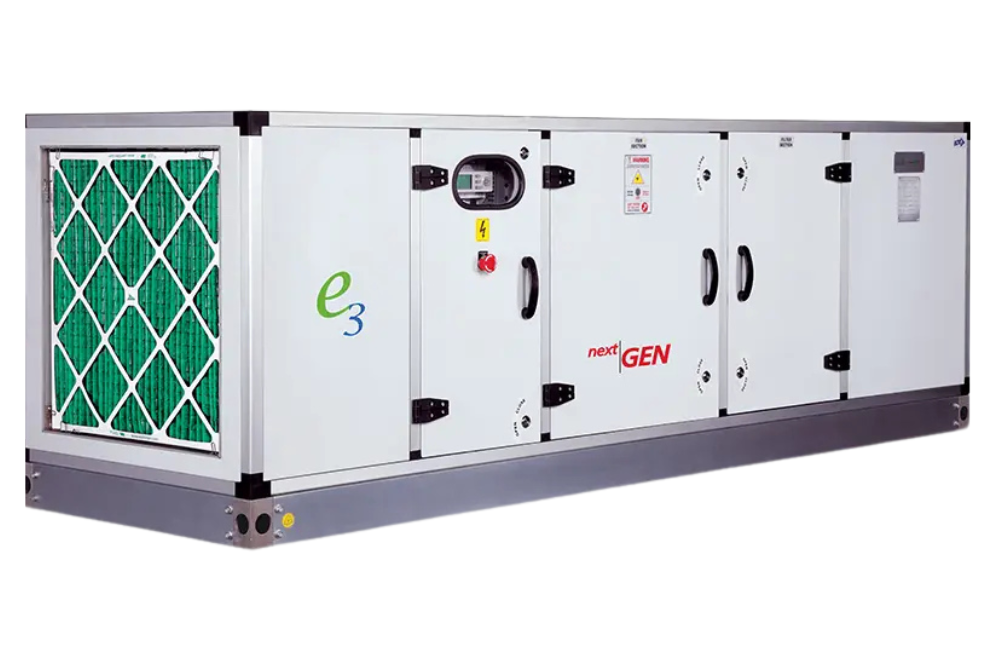
The E3 Next Gen Air Purification System has capability to remove harmful indoor and outdoor pollutants like atmospheric gases, odour, biological contamination, VOC’s and other compounds while maintaining particulate matter (PM-10, PM-2.5 & PM-1) levels, thus affecting the overall air quality. Our range of gas adsorption filter easily removes these process gases and purifies the contaminated space.

Technical Specifications

  1. Power Supply: Single/ Three Phase.
  2. Filter: Up to 5 stages.
  3. Air Volume: 1200 CFM to 6000 cfm

Features

  1. Integrated with best available filtration media with unique radial pleat design filter
  2. Electronically Commutated (EC) fans are provided with an integrated frequency converter for step-less load control, having impeller with low aerodynamic losses thus resulting in extremely high efficiency and silent operations.
  3. Option of having Plug Fans with IE2, IE3 and IE4 motors with factory fitted VFD also available.
  4. Unique design profile and panel made with corrosion resistant aluminium to meet the international standard for leakage class.
  5. Rigid frame work design inherent to the casing strength and stability.
  6. Packaged with grand features like inbuilt electrical control panel with intelligent controls and sensors for automation that leads to optimum efficiency and major energy savings
  7. Highly efficient and low pressure drop filtration technology to maintain permissible PM 2.5 levels.

Benefits

  1. Better IAQ
    Very effective against PM-2.5 to PM-10 range particulate matter sizes.
    For adsorption of odours, vapours and gases in air conditioning applications.
    Multi-layered activated carbon media gives high performance against the suspended molecules exploiting the benefits of Rapid Adsorption Dynamics (RAD).
    Highly effective against Molecular pollutants released from external sources (traffic fumes, power generation, industry etc.)
  2. Human Comfort
    Highly effective against Respirable Suspended Particulates (RSP) with nominal aerodynamic diameter of 10 µm or smaller.
  3. Corrosion Prevention Filters
    Highly effective in sub-tropical industrialised climatic conditions.
    Checks the tendency of unexpected failure of the machinery components due to rusting.
    Ability to successfully remove Sulphur compounds and chloride ions causative agents for atmospheric corrosion.
  4. Easy to adjust the air flow to accommodate exact needs.

Optional Accessories

  1. For treating atmospheric gases, Multiple combination of filter media are availablelike:
    Particles only
    Particles, VOCs and Ozone
    Particles and Formaldehyde
    Particles, VOCs, Ozone and Formaldehyde.
    Particles, Acids and gases.
  2. On demand, the unit can be custom-made with UVGI or PHIO+ specifications
  3. Other available accessories:
    Pressure drop Alarm.
    On-Off timer
    IOT/Digitally controlled user interface to check and monitor air quality over internet.

Applications And Suitability

  1. Ideal for all applications where fresh air is a must
  2. Ideal for hospitals and healthcare industry.
  3. Suitable for removing odour from public buildings and waste treatment

Main Components of a Process Chiller

An Industrial Process Chiller is made up of several essential components that work together to regulate temperature and ensure smooth operation. Each part plays a crucial role in the refrigeration cycle:
  1. Compressor:
    This is the heart of the chiller. It compresses the refrigerant gas, increasing its pressure and temperature so it can move through the system efficiently. Types of compressors include scroll, screw, reciprocating, and centrifugal, depending on the chiller’s capacity and design.
  2. Evaporator:
    The evaporator is where the process fluid (such as water or glycol) passes through and loses its heat to the refrigerant. This is where heat absorption occurs, and the refrigerant turns into a gas.
  3. Condenser:
    After compression, the hot refrigerant gas flows into the condenser. In this component, the heat is removed either by air (air-cooled) or water (water-cooled), and the refrigerant changes back into a liquid.
  4. Expansion Valve:
    The expansion valve regulates the flow of refrigerant into the evaporator. It reduces the pressure and temperature of the liquid refrigerant before it re-enters the evaporator to absorb more heat.
  5. Process Pump & Reservoir:
    A circulation pump pushes the cooled fluid to the process and brings the warmed fluid back to the chiller. The reservoir holds the process fluid and acts as a buffer to handle thermal loads.
  6. Control System:
    Modern chillers come with advanced control panels and sensors that monitor and regulate temperatures, flow rates, pressures, and operating parameters for safety, efficiency, and precision.
    Together, these components form a reliable and energy-efficient system that keeps industrial operations stable, regardless of heat-generating activities within the facility.
Subscription Form