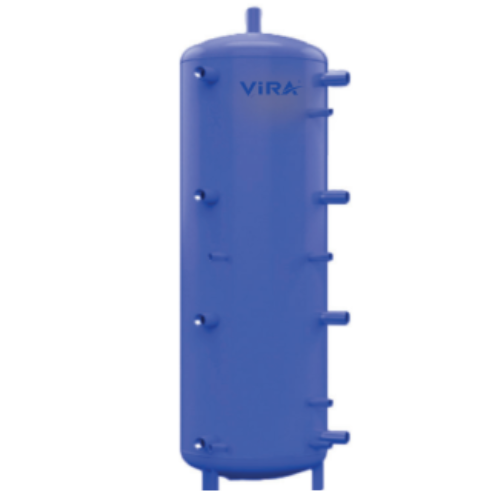
A Buffer Tank is a vessel used in heating, cooling, or combined HVAC systems to store thermal energy and help manage temperature fluctuations and system cycling. Its primary purpose is to act as a thermal reservoir, absorbing and releasing heat as needed to maintain system stability and efficiency.
In a heating or chilled water system, water is heated or cooled by a boiler, heat pump, or chiller. However, if the system demand is intermittent or too low, frequent on-off cycling can occur, which reduces the efficiency and lifespan of the equipment. A buffer tank mitigates this issue by providing additional volume of water that smooths out these fluctuations. It stores excess hot or cold water and supplies it back when the system requires it, reducing short cycling and ensuring consistent temperatures.
Buffer tanks are commonly used in systems with variable loads, multiple zones, or heat pumps, and are installed between the heat source and the distribution system. They do not contain any internal coils or moving parts—just insulated, pressurised tanks designed to retain heat or cold. Their capacity varies depending on system size and application, and they are an essential component for improving overall energy efficiency, system reliability, and thermal performance.
Inventure offers Buffer Tanks manufactured by ViRA – Turkey customized as per project requirement.
A Buffer Tank is an essential component in chilled water or hot water HVAC systems, designed to increase system fluid volume, stabilize temperatures, and reduce equipment cycling. Its construction is engineered for durability, thermal efficiency, and long-term system performance.
1. Outer Shell (Tank Body)
Material:
Carbon Steel – Most commonly used for standard applications.
Shape:
Cylindrical (horizontal or vertical design based on space and installation needs).
Thickness:
Designed per ASME standards or relevant pressure vessel codes.
Thickness varies based on pressure ratings (typically 6–10 bar standard, higher if required).
2. Internal Volume
Capacity:
Ranges from 100 liters to several thousand liters, depending on system size.
Purpose:
Holds additional system fluid to increase thermal mass, stabilizing temperature fluctuations.
3. Insulation
Material:
Polyurethane Foam (PUF)
Rockwool
Fiberglass
Purpose:
Minimizes heat loss (in heating systems) or prevents heat gain (in chilled water systems).
Thickness:
Typically 25–100 mm, depending on temperature range and application.
4. Inlet & Outlet Connections
Pipe Connections:
Located at strategic positions to ensure proper fluid mixing and flow direction.
Typically threaded or flanged nozzles, as per system requirements.
Connection Types:
Primary Loop Connection – From chiller or boiler.
Secondary Loop Connection – To system distribution.
5. Drain Valve
Location:
Installed at the tank’s lowest point for easy draining during maintenance.
6. Air Vent / Air Release Port
Purpose:
Removes trapped air during filling or operation, preventing air lock.
Type:
Manual or automatic air vent.
7. Temperature Sensor Ports / Thermowells
Purpose:
Allow placement of temperature sensors for system monitoring and control.
Placement:
Typically at both the top and bottom to monitor stratification.
8. Mounting Supports
Vertical Tanks:
Equipped with support legs or base plates for floor mounting.
Horizontal Tanks:
Mounted on saddles or cradles for stability.
An Industrial Process Chiller is made up of several essential components that work together to regulate temperature and ensure smooth operation. Each part plays a crucial role in the refrigeration cycle: