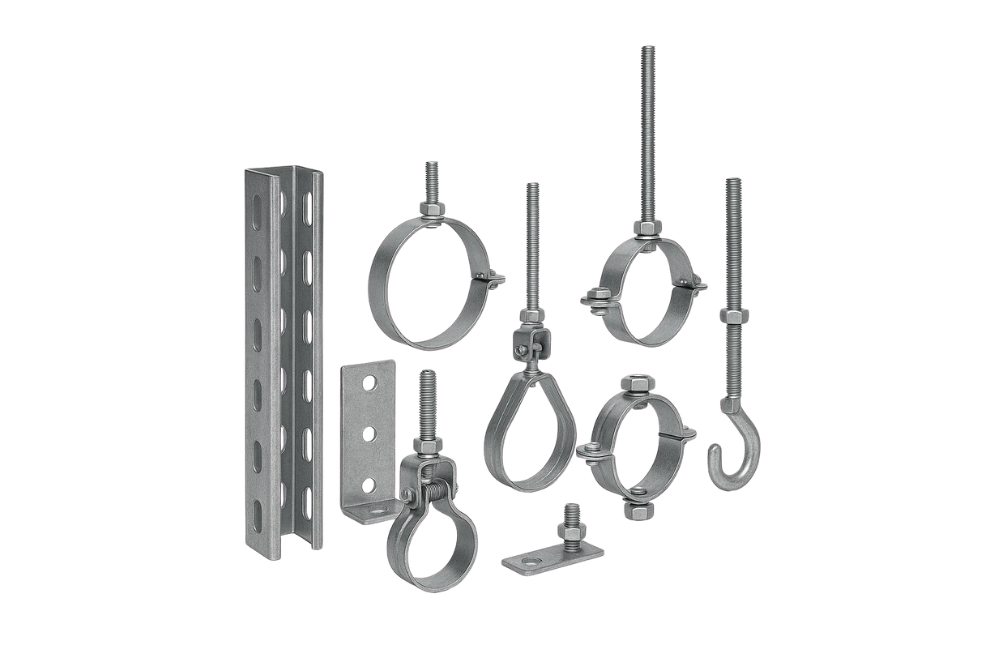
Inventure offers a comprehensive range of MEP pipe and duct supports, catering to mechanical, electrical, and plumbing applications across commercial, residential, and industrial projects. Our products are engineered for durability, easy installation, vibration and noise reduction, and reliable load-bearing capacity.
Product Range1. Beam & Hanger SupportsDesigned to suspend or support pipes, ducts, and equipment from structural beams.Beam – Primary structural element for supporting piping systems and mechanical loads.Beam Clamps – Attach directly to beams for suspending pipes or equipment without drilling.Clevis Hanger – Heavy Duty – Suitable for larger/heavier pipes in industrial applications.Clevis Hanger – Standard Duty – For medium-weight pipes; commonly used in HVAC and plumbing systems.2. Pipe SupportsSecure, stabilize, and guide piping systems to prevent sagging, vibration, or movement.PE Pipe Support – For polyethylene pipes, commonly used in water supply or chemical pipelines.PUF Support – Pre-insulated support with polyurethane foam for thermal insulation in chilled water or HVAC systems.Riser Clamps – Support vertical pipes (risers) and prevent movement.Roller Hanger – Allows axial pipe movement, ideal for long pipelines or expansion loops.Roller Chair – Supports horizontal pipe movement; suitable for thermal expansion and long-span piping.
3. ClampsHold or secure pipes while allowing some adjustment or flexibility.Plain Split Clamps – Basic clamps for simple and cost-effective pipe support.Rubber Lined Split Clamps – Reduce vibration and noise while protecting pipe surfaces.Sprinkler Clamps – Heavy Duty – For larger fire sprinkler pipes; robust and stable.Sprinkler Clamps – Standard Duty – For smaller or standard sprinkler systems.U Strap Clamps – U-shaped clamps for attaching pipes to structures.U Bolts – U-shaped bolts to secure pipes to walls, beams, or supports.4. Rubber & Insert SupportsProvide cushioning, vibration absorption, and protection for piping systems.Rubber Support Insert – Prevents noise, vibration, and damage to pipes from clamps or hangers.
5. Structural SupportsChannels, rods, and framing for mounting and supporting piping or duct systems.Channels – Standard metal channels for suspending pipes or equipment.Slotted Channel – Pre-punched slots for flexible positioning and easy assembly.Unistrut Channel – Modular steel framing system for mechanical and electrical installations.Threaded Rods – Connect channels, clamps, and hangers to ceilings or beams with adjustable height.6. Anchoring & FixingSecure supports and structures to concrete or other structural surfaces.Anchors – Drop-in, wedge, and expansion anchors for securing channels, rods, or hangers to concrete or masonry.Inventure’s MEP supports are ideal for HVAC, plumbing, fire protection, and industrial piping systems, ensuring reliable performance, safety, and compliance with international standards.